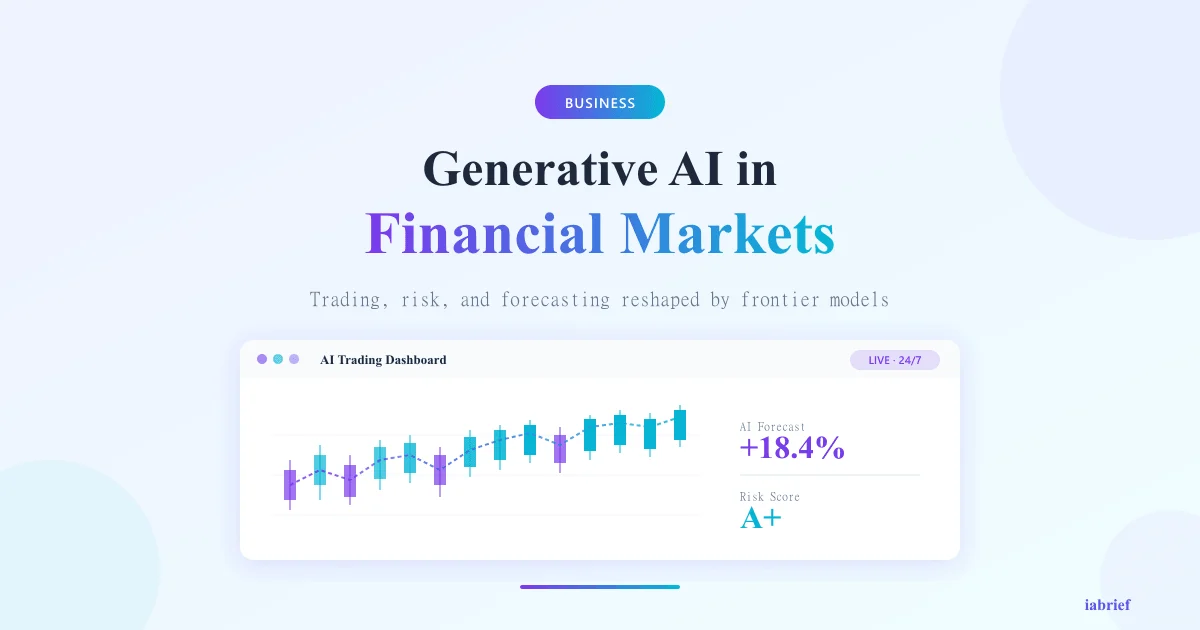
Generative AI in Financial Markets: How Investors and Banks Are Using It in 2026

Financial markets will never be the same. In 2026, generative AI has graduated from promise to infrastructure, an invisible technology layer that already analyzes portfolios, drafts regulatory filings, detects fraud in real time, and steers credit decisions in milliseconds. What used to require entire teams of analysts now runs on language models trained on decades of financial data.
For investors and managers who still treat AI as a “future trend,” this article is both a warning and an opportunity: the transformation is already underway, and whoever understands the real use cases will move ahead.
What Is Generative AI and Why Finance Adopted It Fast
Generative AI refers to models capable of creating content, text, analysis, reports, simulations, from large volumes of data. Unlike traditional AIs that only classify or predict, generative models reason over data and produce contextualized outputs.
The financial sector was one of the first to adopt at scale for three reasons:
- High-volume structured data: balance sheets, time series, regulatory filings — all in formats that feed language models with high-quality signal.
- High cost of error: any automation that reduces human error in compliance or analysis has immediate ROI.
- Mounting regulatory pressure: mandatory reports, audits, and risk documentation require continuous text generation, a perfect job for generative AI.
Real Use Cases in 2026
1. Asset Analysis and Automated Research
Mid- and large-sized asset managers are already using generative AI to produce research reports in minutes. The model ingests earnings data, macro indicators, market news, and price history, then outputs a structured document with the investment thesis, risks, and scenario projections.
Real impact: an asset manager that used to take 3 days to publish a coverage report now ships it in hours, with a human analyst reviewing and validating, not building from scratch.
Platforms like Bloomberg Terminal already integrate generative AI assistants that answer complex questions like “what’s the historical impact of rate hikes above 50bps on growth companies with P/E > 30 in the S&P 500?”, and deliver the answer in natural language with up-to-date data.
2. Automating Regulatory Reporting and Compliance
Compliance is one of the areas where generative AI shows the highest ROI. Financial institutions spend billions every year on staff dedicated exclusively to producing reports for regulators — the SEC, FINRA, the FCA, and the Federal Reserve.
In 2026, models like GPT-4o and Claude 3.7 are used to:
- Draft AML (Anti-Money Laundering) reports based on monitored transactions
- Auto-generate Suspicious Activity Reports (SARs) when suspicious patterns are detected
- Produce risk committee minutes from position and trading data
Important risk: regulation requires a responsible human to sign off on the documents. AI accelerates the work, it doesn’t eliminate fiduciary responsibility.
3. Risk Management and Fraud Detection
Generative models are being combined with specialized neural networks to build next-generation fraud detection systems. While classical models detected known patterns, generative AI can simulate how a fraudster would think, and flag attempts that have never happened before.
The edge lies in generating synthetic fraud scenarios to train detectors: the model learns to recognize what doesn’t yet exist in the real-world data history.
4. Visa Intelligent Commerce Connect: A Standout Real-World Case
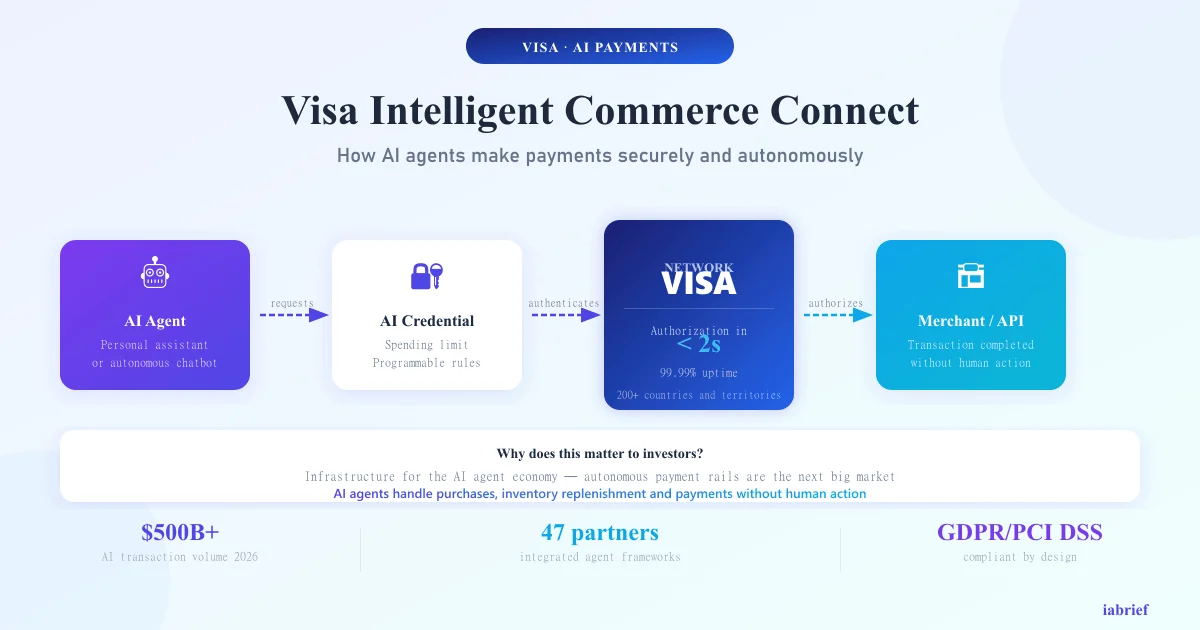
One of the most-discussed cases of 2025-2026 in payments is Visa Intelligent Commerce Connect, a platform that uses generative AI to plug AI agents (personal assistants, e-commerce chatbots) directly into Visa’s payments ecosystem.
The principle is simple and powerful: as autonomous AI agents start making purchases on behalf of human users — automatic restocking, bill payments, scheduled purchases, the payments infrastructure has to recognize, authenticate, and authorize those transactions safely.
Visa built credentials specifically for AI agents, with spending controls, programmable authorization rules, and API integration with the leading agent frameworks on the market.
Why it matters for investors? Visa Intelligent Commerce Connect signals an enormous emerging market: infrastructure for the AI-agent economy. Companies that build payment rails, authentication, and compliance for autonomous transactions will sit at the center of one of the biggest shifts in digital commerce.
5. Personalized Financial Products
Digital banks and fintechs use generative AI to build hyper-personalized experiences: the model analyzes a customer’s financial profile, behavioral history, and stated goals, then suggests products, credit limits, and tailored investment strategies, all in natural language, like a conversation.
This goes beyond simple recommendations. Platforms from JPMorgan, Goldman Sachs’s Marcus, and challenger banks like Chime and Revolut are testing AI assistants that “know” the investor’s profile and adjust portfolios in real time, explaining each decision in plain English.
Regulatory Risks: What Managers Need to Watch
The fast adoption of generative AI in finance has surfaced a new set of regulatory risks managers need to understand.
AI Regulation in the US and EU
The EU AI Act, in force across the European Union, sets obligations for high-risk AI systems, a category that covers systems used in credit decisions, financial scoring, and investment selection. In the US, the SEC has issued guidance on AI-driven investment advice, and the OCC and Federal Reserve have published supervisory expectations for model risk management. Common obligations include:
- Transparency about AI use in decisions affecting the customer
- The right to contest automated decisions
- Joint accountability between the system provider and the institution deploying it
Hallucination Risk in Financial Reporting
Generative models can “hallucinate” — produce plausible but incorrect information. In risk analysis or regulatory filings, an invented data point can have severe consequences. That’s why the industry is moving toward RAG-based models (Retrieval-Augmented Generation): the AI only states what it can retrieve and cite from verifiable sources.
Algorithmic Bias and Discrimination
Models trained on historical data can carry biases forward, denying credit to specific demographic profiles, for example. Regulators including the SEC, the CFPB, and the Federal Reserve are developing audit frameworks specifically for AI in finance.
Opportunities for Investors in 2026
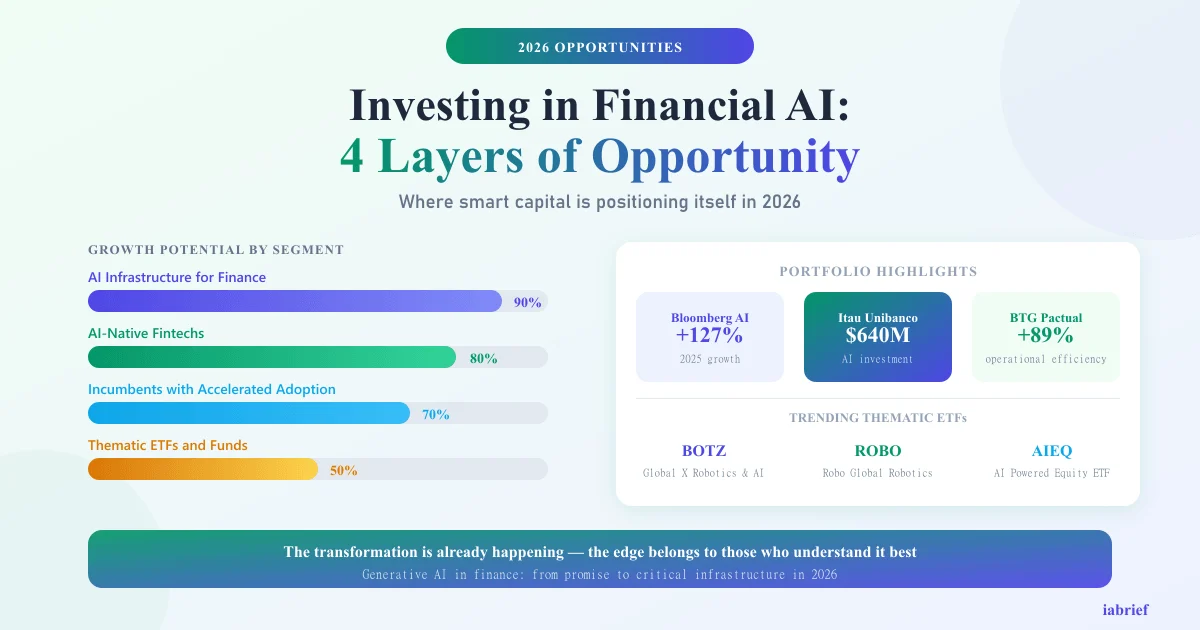
The generative AI shift in finance creates investment opportunities across multiple layers:
Financial AI Infrastructure Companies
- Providers of models specialized in financial data (Bloomberg AI, Morningstar AI)
- Data infrastructure and RAG providers for compliance
- Cybersecurity companies focused on protecting financial AI systems
AI-Native Fintechs
- Wealth management platforms built on generative AI
- AI-driven KYC/AML solutions
- Contract analysis and due diligence tools for M&A
Incumbents Accelerating Adoption
Large banks and asset managers investing heavily in AI tend to cut operating costs structurally. JPMorgan, Goldman Sachs, Morgan Stanley, and BlackRock reported billion-dollar AI investments in 2025, and the results are starting to land on the balance sheets.
ETFs and Thematic Funds
For investors who prefer diversified exposure, ETFs focused on AI and financial automation grew significantly in 2025-2026. Examples: BOTZ, ROBO, AIQ, and ARKQ.
How to Get Started: A Practical Playbook for Finance Pros
If you work in finance and want to understand how generative AI can be applied in your day-to-day, here’s a practical playbook:
- Try the native tools: Bloomberg Terminal with integrated AI, ChatGPT with financial data plugins, or Claude for analyzing long documents like prospectuses and 10-Ks.
- Map your repetitive processes: monthly reports, portfolio analyses, regulatory communications, anything that follows a fixed template is a candidate for generative AI automation.
- Stay current on regulation: track the EU AI Act, SEC guidance on AI, and updates from the OCC and Federal Reserve on automated investment systems.
- Invest in upskilling: prompt engineering for financial analysis is already a differentiator. Online courses on Coursera and DataCamp offer specialized tracks for the sector.
Conclusion: Generative AI Is the New Financial Infrastructure
In 2026, the question is no longer “if” generative AI will transform financial markets — it already has. The right question is: what’s your stance on the change?
For investors, there are clear opportunities in infrastructure, AI-native fintechs, and incumbents accelerating adoption. For finance professionals, generative AI is a productivity multiplier that demands understanding, not fear. And for managers, now is the time to map use cases, evaluate regulatory risks, and build competitive advantage before it becomes commodity.
The transformation is already happening. The edge belongs to whoever understands it best.
Want weekly analysis on AI and financial markets? Subscribe to our newsletter and stay ahead of the trends.
Suggested image alt texts:
- Image 1 (hero): “Generative AI dashboard analyzing an investment portfolio in real time”
- Image 2 (compliance): “Compliance professional reviewing an AI-generated report for financial regulators”
- Image 3 (Visa AI): “Diagram of Visa Intelligent Commerce Connect integrating AI agents with payments”
- Image 4 (opportunities): “Chart showing investment growth in AI for the financial sector 2024-2026”
Related reading
To go deeper, we recommend these iabrief articles:
- OpenAI’s $852 Billion Valuation in 2026: The Largest Private Funding Round in History
- Week in AI: agents at work, Gemini in cars and AI beating doctors (May 3, 2026)
- How to Use Google Veo 3.1 to Create AI Videos: Step-by-Step Tutorial (2026)
Official sources
For deeper context, see the official sources and authoritative references below: