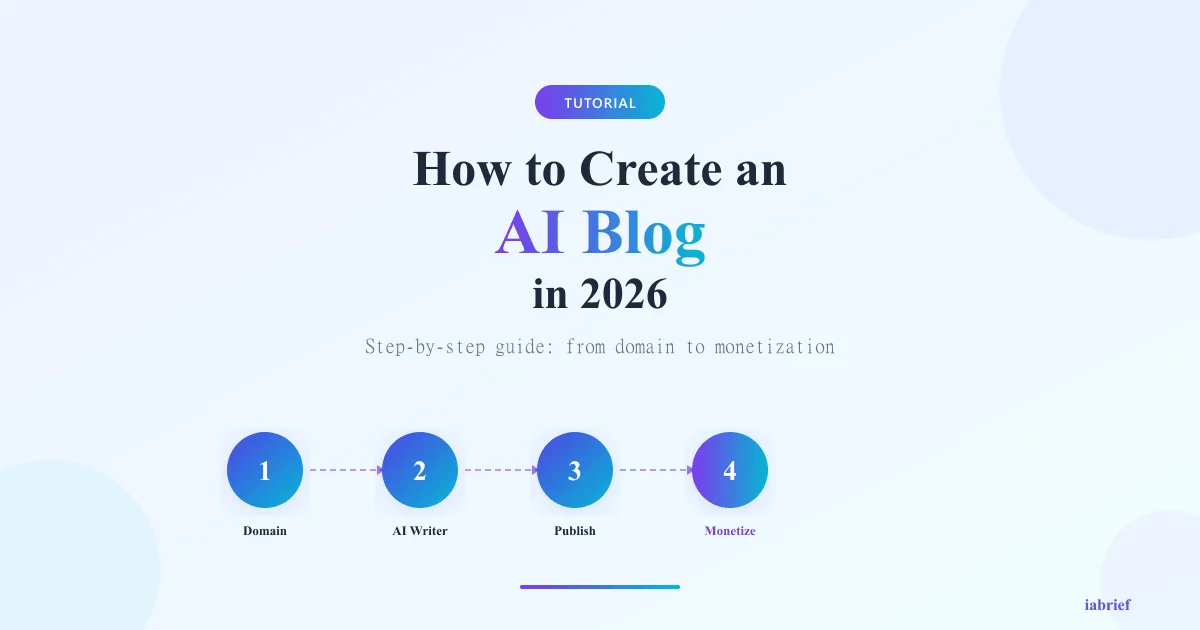
How to Create an AI Blog in 2026 That Ranks on Google

If you’ve ever thought about monetizing a blog and wondered which niche has the most traffic, the most demand, and the most money on the table right now, the answer in 2026 is simple: artificial intelligence.
The AI niche has exploded. Tools like ChatGPT, Gemini, and Perplexity have become part of daily life for millions of people, and most of them are searching for content to figure out how to use these technologies, which tools are best, how to make money with them, and what’s coming next.
In this complete guide, you’ll learn, step by step, how to build an AI blog that lands on the first pages of Google, and how to turn that traffic into real revenue.
My Experience (From the Author)
The blog you're reading right now is the direct result of the method I describe here. I started iabrief in April 2026 believing that AI plus human review could produce better content than the usual generic tech blogs. In a little over a month we hit 88 published articles in PT and EN, each one going through the human fact-check flow described in this article. This isn't theory — it's what's running on the other side of the screen as you read.
Why Start an AI Blog in 2026?
The global AI market is projected to surpass USD 1 trillion by 2030, according to industry forecasts. Adoption is accelerating across the US, Europe, and emerging markets alike: small and mid-sized businesses, freelancers, and students search every day for answers about automation, productivity, and AI tools.
That creates a massive window of opportunity for content creators:
- Growing search volume: terms like “best AI for writing,” “how to use ChatGPT,” and “free AI tools” pull in hundreds of thousands of monthly searches in English alone.
- Manageable competition: unlike finance or health, most AI niche competitors still haven’t mastered technical SEO and high-quality pillar content production.
- Diversified monetization: AI SaaS affiliate programs pay recurring commissions in dollars, refer once, earn every month.
- Long shelf life: as long as AI keeps moving, new tools, use cases, and questions will keep coming. Your content pipeline never runs dry.
Step 1: Pick the Right Angle for Your AI Blog
Don’t bother launching a generic blog about “artificial intelligence.” The niche is too broad to rank for everything. You need an angle — a specific cut that defines who you serve and which problems you solve.
A few angles with strong potential in 2026:
| Angle | Audience | Sample topic |
|---|---|---|
| AI for entrepreneurs | Small business owners | “How to automate customer support with AI” |
| AI for content creators | YouTubers, writers, designers | “Best AI tools for editing videos” |
| AI for students | College students, exam takers | “How to use ChatGPT to summarize PDFs” |
| AI tool reviews | Working professionals | “ChatGPT vs Gemini vs Claude in 2026” |
| Making money with AI | Online income beginners | “How to create AI content and sell as an affiliate” |
Recommendation: start with the “AI for entrepreneurs and content creators” angle. It offers the best mix of search volume, purchase intent, and an audience willing to pay for tools.
Step 2: Keyword Research for the AI Niche
Keyword research has evolved in 2026. Google no longer ranks isolated keywords, it understands entities, topics, and semantics. That means you need to cover a theme in depth, not just repeat a target keyword.
How to Run the Research
1. Start with the reader’s problem, not the tool
Instead of searching for “ChatGPT,” think about the underlying problem: “how to write faster,” “how to reply to emails automatically,” “how to create social media posts with AI.” Those queries have clear intent and convert better.
2. Use both free and paid tools
- Google Search Console: shows exactly which terms your site already appears for (use it as soon as your first pages are indexed).
- Google Trends: compare term growth over time.
- Ubersuggest / Semrush (free tier): find search volume and ranking difficulty.
- AnswerThePublic: generates real questions people ask about AI.
- ChatGPT and Gemini: ask for a list of long-tail keywords on a topic, you’ll be surprised by the quality.
3. Prioritize long-tail keywords
Short terms like “artificial intelligence” have huge volume and impossible competition for a new blog. Go for:
- “how to use AI to write blog posts” (clear intent, lower competition)
- “best AI tool for small businesses” (purchase intent)
- “how to automate social media with ChatGPT” (tutorial, easier to rank)
4. Build a topic map
Organize your keywords into clusters:
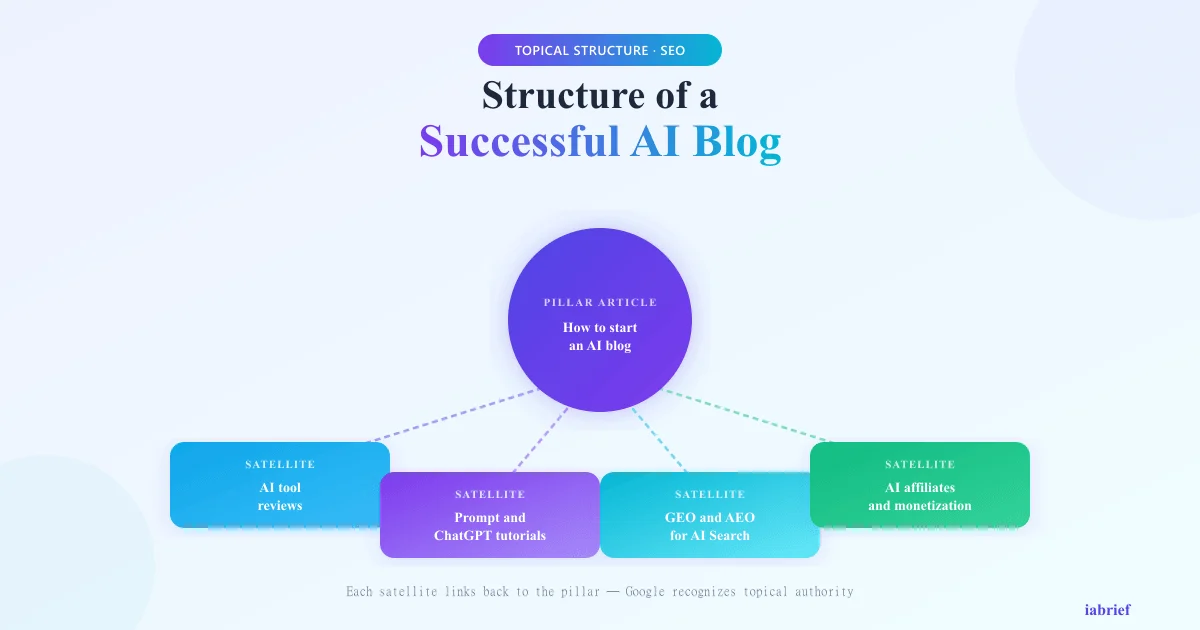
- Pillar topic: “How to build an AI blog” (this article)
- Satellite subtopics: best AI tools for blogs, how to use ChatGPT to write articles, how to monetize a blog with AI affiliates, etc.
Each subtopic becomes an article that links back to the pillar. This builds topical authority, one of the top ranking factors in 2026.
Step 3: A Content Structure Google (and the AIs) Love
In 2026, Google and generative AI engines (ChatGPT, Perplexity, Gemini) use similar criteria to decide which content to surface: depth, structural clarity, E-E-A-T, and citability.
The E-E-A-T Framework Applied to an AI Blog
E-E-A-T stands for Experience, Expertise, Authoritativeness, and Trustworthiness. Google evaluates these to decide if your content deserves prime placement.
In practice:
- Real experience: write like someone who actually uses the tools, not someone who read about them. Include screenshots, real results, mistakes you made.
- Expertise: be specific. Instead of “ChatGPT is great for marketing,” say “using prompt X, I cut content production time by 40%.”
- Authority: cite credible sources, mention data, link to studies.
- Trustworthiness: have an “About” page, show who you are, keep the blog updated.
Ideal Article Structure for AI Content in 2026
“`
H1, Main title with keyword
Opening paragraph, directly answers the main question (GEO/AEO)
H2 — Section 1 (context or “why this matters”)
H2, Section 2 (step-by-step or core concept)
H3, Subtopic 1
H3, Subtopic 2
H2 — Section 3 (tools, practical examples, comparisons)
H2, Section 4 (monetization, next steps, or advanced tips)
H2, Conclusion with CTA
“`
Pro tip: drop a direct, concise answer in the first two paragraphs. Generative AI engines (and Google’s AI Overviews) love pulling quick answers. If you respond fast and well, you’re far more likely to be cited.
Step 4: How to Compete With the Big Sites in the AI Niche
You’ll run into competitors like TechCrunch, The Verge, Wired, Mashable, and translated international sites. The good news: they have weaknesses a specialist blog can exploit.
Where the Big Sites Fall Short
- Zero depth: they write for the quick click, not to actually solve the problem.
- No real experience: they cover tools they’ve never used.
- Slow updates: an article published in 2024 still sits there with no refresh.
- They don’t optimize for GEO/AEO: ignoring the new AI search layer entirely.
How to Win With Specialist Content
1. Go deeper. If a major site has an 800-word article on “what is ChatGPT,” publish a 3,000-word guide on “how to use ChatGPT to build a business from scratch in 30 days”, with screenshots, real examples, and results.
2. Update fast. The AI niche shifts every week. A new tool version, a new model, a fresh controversy — if you publish first and publish well, Google rewards it.
3. Create original content with data. Run your own tests (“I tested the 5 best AI writing tools, here’s what happened”), compile research, interview users. Original content is hard to copy and naturally attracts backlinks.
4. Topical authority vs. domain authority. Big sites have heavy DA, but they don’t cover AI with thematic depth. If you publish dozens of interlinked articles on an AI subtopic, Google will recognize you as the authority on that subtopic, even as a smaller site.
Step 5: Optimize for AI Search — GEO and AEO
This is the big shift of 2026. Beyond ranking on traditional Google, you need to get cited by generative AI engines: ChatGPT, Perplexity, Google AI Overviews, and Gemini.
Studies show more than 60% of Google searches now end without a click to an external site, the AI answers directly. To stay relevant, your blog needs to be the source the AI pulls from.
GEO, Generative Engine Optimization
GEO is the practice of structuring content so generative AIs cite it. Core techniques:
- Direct answer up front: open every section with a clear, specific answer before expanding.
- Lists and tables: AIs love extracting structured information.
- Cited data and sources: “according to a McKinsey study” or “Semrush data shows” boost credibility and citation odds.
- FAQ section: question-and-direct-answer pairs get pulled by AI Overviews constantly.
- Schema markup: implement FAQ, HowTo, and Article Schema in WordPress or your CMS.
What Each AI Prefers
Each AI search engine has its own preferences:
- ChatGPT: values brand authority and consistent source mentions across the web.
- Perplexity: prioritizes sources with verifiable links and detailed technical content.
- Google AI Overviews: favors content from Google’s own ecosystem (but also cites well-structured external sites with strong E-E-A-T).
The most effective play is combining traditional SEO with GEO: rank in organic results while you build citability inside the AIs.
Step 6: Monetization, How to Make Money With Your AI Blog
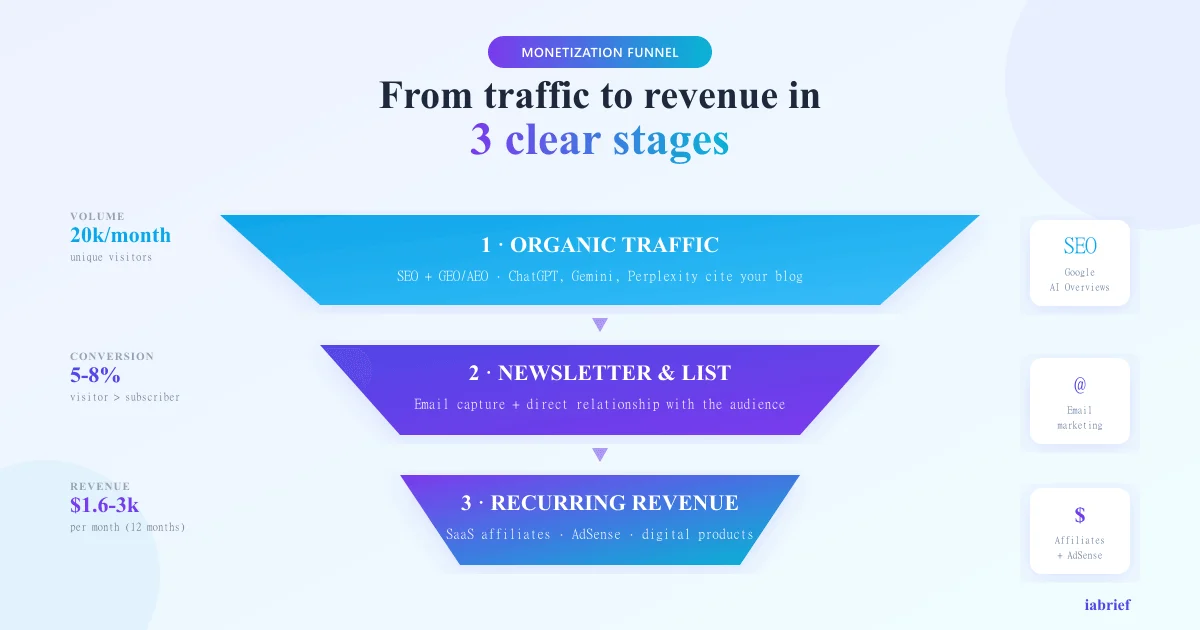
A well-executed AI blog can generate revenue across multiple channels. In 2026, the smartest move is to diversify from day one.
1. AI SaaS Affiliates (Highest Potential)
This is the gold mine of the niche. AI tools run on recurring subscriptions, you refer once and earn a commission every month for as long as the user keeps the plan.
High-potential affiliate programs in 2026:
| Tool | Commission | Notes |
|---|---|---|
| Jasper AI | 30% recurring | AI writing tool |
| Writesonic | 30% recurring | Jasper alternative |
| Surfer SEO | 25% recurring | AI-powered SEO optimization |
| SEMrush | up to 40% | Full SEO suite |
| Copy.ai | 45% recurring | AI marketing copy |
| Canva (Pro) | 20-80% | AI-powered design |
How to monetize affiliates well:
- Write honest, in-depth reviews of every tool.
- Build comparisons (“Jasper vs Copy.ai: which one wins in 2026?”).
- Create usage tutorials that naturally feature the product.
- Never force the recommendation, readers see right through it.
2. Ads (AdSense and Premium Networks)
AdSense still works for volume, but RPM (revenue per thousand pageviews) in tech and AI is one of the highest in the market, between $4 and $16 per thousand pageviews depending on traffic and audience.
For even better results, once you hit 50k pageviews/month, apply to premium networks like Mediavine or Raptive (formerly AdThrive), which pay well above AdSense.
3. Digital Products
Once you’ve built authority, you can launch:
- E-books: “50 ChatGPT prompts for entrepreneurs” (low production cost, high margin).
- Online courses: advanced tutorials on specific AI tools.
- Prompt templates: sell prompt packs tailored to specific niches.
4. Sponsored Newsletter
A weekly AI newsletter builds a direct audience — algorithm-independent. With 5,000+ engaged subscribers, you can land tech-niche sponsors paying $100 to $500 per issue.
Step 7: Essential Tools for Your AI Blog
You don’t need to spend much to get started. Here’s the minimum viable stack:
Platform and Hosting
- WordPress.org with hosting on Hostinger or Bluehost ($3–8/month). It’s the most flexible option for SEO.
SEO Plugins
- RankMath (free with advanced features) or Yoast SEO: configure meta descriptions, slugs, sitemaps, and schema markup automatically.
AI Content Production
- ChatGPT (GPT-4o): research, article structure, draft generation.
- Gemini: excellent for market research and competitor analysis.
- Perplexity AI: search with verifiable sources, great for backing articles with real data.
Heads up: use AI to accelerate production, never to replace human curation. Google penalizes AI-generated content with no real added value. Use AI for the draft and structure; you bring the experience, opinion, and depth.
Analytics and SEO
- Google Search Console: track impressions, clicks, and keywords (free and mandatory).
- Google Analytics 4: understand user behavior.
- Ubersuggest or Semrush (free tier): keyword research.
Design and Imagery
- Canva: create thumbnails, infographics, and article images.
- Ideogram or Midjourney: AI image generation to illustrate content.
A Realistic Timeline: From Zero to First Results
A lot of people give up before seeing results because their expectations are wrong. Here’s a realistic timeline:
| Period | Goal | Key actions |
|---|---|---|
| Month 1–2 | Setup and first 10 articles | Configure blog, write pillar and satellite articles |
| Month 3–4 | First indexations and clicks | Optimize published articles, publish 2–3x/week |
| Month 5–6 | 1,000–3,000 pageviews/month | Focus on long-tail keywords and internal linking |
| Month 7–9 | 5,000–15,000 pageviews/month | First affiliate revenue, activate AdSense |
| Month 10–12 | 20,000+ pageviews/month | Scale production, newsletter, digital products |
SEO takes time. Most meaningful results show up between months 6 and 12. Publishing consistency is the biggest factor in getting there.
Mistakes That Will Kill Your AI Blog (and How to Avoid Them)
1. Publishing Shallow AI-Generated Content
Google has increasingly sophisticated detectors for low-value content. A 1,200-word article full of generic phrases will rank for nothing.
Fix: use AI for structure and drafting, but layer in personal experience, real data, opinions, and concrete examples.
2. Ignoring Internal Linking
Every article you publish should link out to other relevant posts on the blog, and receive links back. This distributes authority and helps Google understand your content hierarchy.
3. Not Updating Old Articles
In the AI niche, a 6-month-old article can already be outdated. Schedule periodic reviews of your most-trafficked posts.
4. Relying on a Single Traffic Source
100% organic traffic is vulnerable to algorithm changes. Build a newsletter, an Instagram or LinkedIn presence, and a YouTube channel in parallel.
5. No Monetization Strategy From Day One
Most people wait until they have traffic to think about monetization. Wrong move. From article one, drop relevant affiliate links, set up AdSense, and start thinking about which digital product you can build.
Conclusion: Start Now, Adjust as You Go
Building an AI blog that ranks on Google in 2026 doesn’t require a big budget or advanced technical skills. It requires strategy, consistency, and genuinely useful content.
The ingredients you need:
- A defined angle: who you serve and which specific problem you solve.
- Keyword research: start with long-tail, build topical authority.
- Deep, original content: go further than any of the big sites are going.
- Optimization for AI Search (GEO/AEO): be the source ChatGPT and Gemini cite.
- Diversified monetization: recurring affiliates + ads + digital products.
The AI market isn’t slowing down. Every new tool launched, every new ChatGPT feature, every new Google model is fresh material for your blog — and a fresh shot at traffic.
Start with the first article. Publish the second. Then the third. Results come to people who don’t stop.
CTA: Want the best AI-niche SEO opportunities delivered every week? Subscribe to our free newsletter and stay ahead of the competition.
Related reading
To go deeper, we recommend these iabrief articles:
- OpenAI’s $852 Billion Valuation in 2026: The Largest Private Funding Round in History
- Week in AI: agents at work, Gemini in cars and AI beating doctors (May 3, 2026)
- How to Use Google Veo 3.1 to Create AI Videos: Step-by-Step Tutorial (2026)
Official sources
For deeper context, see the official sources and authoritative references below: