ElevenLabs vs Murf vs Speechify: best text-to-speech tools in 2026

The “elevenlabs vs murf” comparison became standard among creators who need synthetic voice in 2026. And when Speechify enters the conversation, it becomes clear we’re talking about three products with different goals, not three versions of the same thing. Picking the wrong one means paying for features you don’t use or hitting limits you didn’t need to face.
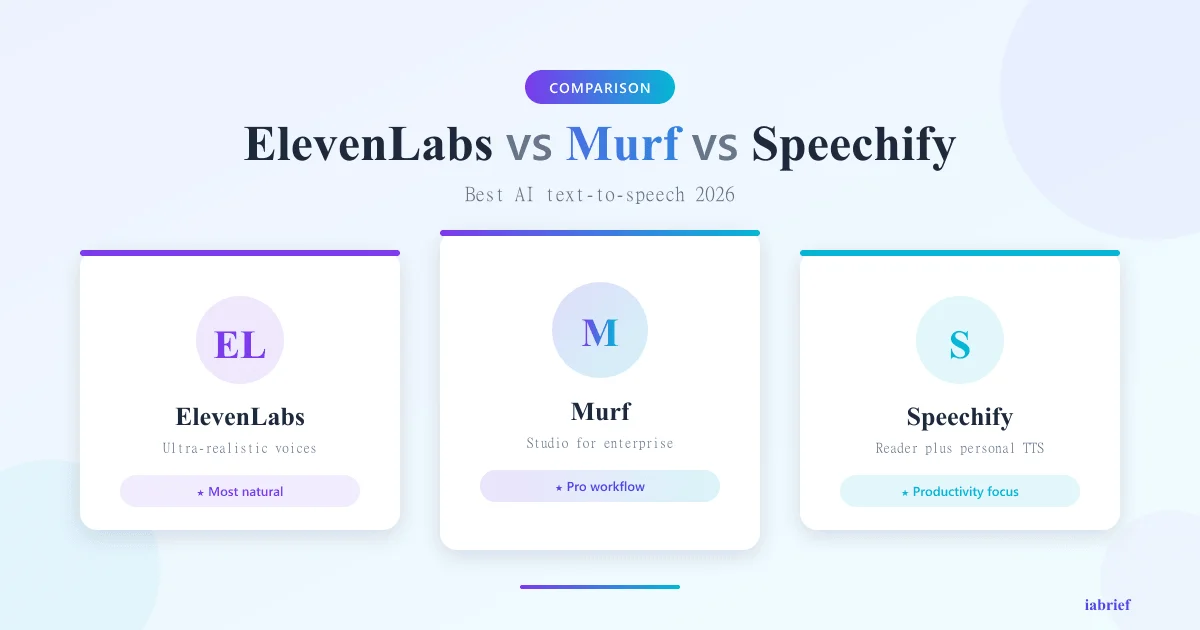
This comparison analyzes the three main text-to-speech (TTS) tools in 2026: ElevenLabs (premium quality and voice cloning), Murf (corporate focus with ready-to-use voices) and Speechify (focus on personal listening and accessibility). We evaluate vocal quality, languages, pricing, use cases and when each one is worth it.
Overview: three different targets
Before comparing, understand who each product chases.
ElevenLabs targets premium creators: youtubers, podcasters, professional audiobooks, dubbing, games. Its quality is a market reference in 2026, with voice cloning that reproduces emotion and cadence. It has a robust API for devs.
Murf targets corporate teams: e-learning, institutional videos, training, voiceovers for presentations. Focus is on a large library of ready voices with good control of pronunciation, emphasis and pauses. Visual editor reminiscent of audio software.
Speechify targets consumers who want to listen, not create: read articles, books, PDFs aloud. Runs as a phone app, browser extension, Kindle integration. Focus on accessibility and personal productivity (ADHD, dyslexia, multitasking).
ElevenLabs in detail
Strengths
- Reference vocal quality: emotion, prosody, natural breathing, often confused with human voice
- Instant voice cloning: 30 seconds of audio produces a reasonable clone; 5+ minutes produces an excellent clone
- Multilingual v2: same voice in ~30 languages keeping vocal identity
- Robust API with low latency (turbo mode for real-time apps)
- Projects: editor for long audiobooks with chapter control
- Sound Effects and Voice Design released in 2024-2025 for extra creativity
- Excellent Portuguese (PT-BR and PT-PT, with controllable accent)
Weaknesses
- High pricing at scale (per-character cost is the highest of the three)
- Voice cloning requires explicit consent, blocks on suspicious uploads
- Free plan limits are low (~10k characters/month)
- Fine-tuning curve (stability/similarity/style settings) requires experimentation
Pricing
- Free: 10k characters/month, 3 custom voices
- Starter: US$ 5/month — 30k characters
- Creator: US$ 22/month, 100k characters + instant voice cloning
- Pro: US$ 99/month, 500k characters + full commercial use
- Scale/Business: US$ 330+/month — high volume and enterprise features
Murf in detail
Strengths
- Huge ready-voice library (200+ voices in 20+ languages, 2026)
- Timeline-style visual editor: drag text blocks, adjust pause, emphasis, speed
- Murf Studio: integrates TTS with background music, slide imports (PPT, Google Slides)
- Corporate focus: e-learning, video voiceover, institutional narration
- Collaborative workspace: teams review and approve scripts together
- Integration with Canva, Google Slides and e-learning tools
- Custom pronunciation via glossary (important for technical names/brands)
Weaknesses
- Vocal quality below ElevenLabs in emotion and prosody (but enough for corporate)
- Voice cloning exists (Murf Studio) but with quality below ElevenLabs
- Less mature API than ElevenLabs for devs
- Decent PT-BR but with more “neutral” voices (less expressiveness)
- Hours-per-project billing model confuses those who prefer per-character
Pricing
- Free: 10 minutes of generation, no download
- Creator: US$ 23/month, 24h projects per year + commercial use
- Business: US$ 79/month, 96h, voice cloning, collaboration
- Enterprise: contact, SSO, advanced security
Speechify in detail
Strengths
- Consumption anywhere: iOS/Android app, Chrome extension, Mac/Windows app
- Imports anything: PDFs, Word, Kindle, websites, scans (OCR), emails
- Premium voices (including licensed celebrities) on paid plans
- Adjustable speed up to 4-5x (great for audio skim-reading)
- Persistent position: starts where you stopped on any device
- Accessibility: focus on dyslexia, ADHD, visual impairment
- “Speechify Studio” mode released for creating TTS, but main focus stays on listening
Weaknesses
- Not a professional audio creation tool — those needing to export commercial audio should use ElevenLabs or Murf
- Limited API (Speechify Studio has an option but doesn’t rival)
- Per-user, not per-use pricing: pays off for heavy listeners, not creators
- Voice cloning available but in active development
- PT-BR ok but with fewer voices than English
Pricing
- Free: 10 standard voices, no audio download
- Premium: US$ 11.58/month (annual), premium voices, unlimited reading, OCR
- Speechify Studio Creator: US$ 24/month, professional TTS + voice cloning
- Family/Enterprise: specific plans on request
Head-to-head comparison
| Criterion | ElevenLabs | Murf | Speechify |
|---|---|---|---|
| Premium vocal quality | Excellent | Good | Good |
| Voice cloning | Excellent | Average | Evolving |
| Languages supported | ~30 (multilingual) | 20+ | 30+ (listening focused) |
| PT-BR | Excellent | Good | Good |
| Visual editor | Average | Excellent | N/A (listening focus) |
| Dev API | Robust | Average | Limited |
| Main focus | Premium creation | Corporate/e-learning | Personal listening |
| Billing model | Per character | Per project-hours | Monthly subscription |
| Useful free plan | Yes (10k char) | Yes (10 min) | Yes (standard voices) |
| Paid entry price | US$ 5/month | US$ 23/month | US$ 11.58/month |
| Accessibility (read PDFs/books) | No | No | Excellent |
When to use each
Use ElevenLabs if you:
- Create professional audiobooks, podcasts, YouTube videos
- Need voice cloning with quality that fools human ears
- Work with dubbing, games, animation — anything requiring emotion
- Are a dev integrating TTS into apps, agents or audio products
- Make multilingual content keeping the same voice across languages
Use Murf if you:
- Are a corporate team producing e-learning, training, internal videos
- Want a visual editor that doesn’t require technical audio knowledge
- Work on long scripts with multiple collaborators
- Need a large library of ready voices without configuration
- Generate narration for presentations, pitches, institutional videos
Use Speechify if you:
- Want to listen more than create, read articles, books, PDFs aloud
- Have dyslexia, ADHD or another condition making visual reading tiring
- Have a long commute and want to “read” in audio
- Are a student preferring to review material by listening
- Need accessibility: limited vision, eye fatigue, multitasking
Real scenarios
Independent audiobook in EN/PT-BR: ElevenLabs Pro. Vocal quality is decisive; cost justifies itself by the single production pass.
Corporate e-learning (200 videos/year): Murf Business. Visual editor + hour billing works better than per-character on long scripts.
Podcaster wanting “secondary voice” for narration: ElevenLabs Creator. Voice cloning + Multilingual v2 open new possibilities.
Professional wanting to listen to reports and papers during commute: Speechify Premium. It’s exactly for this.
Dev integrating TTS into voice assistant: ElevenLabs API (turbo mode for low latency) or Murf API (cheaper at corporate volume).
Student with dyslexia reviewing for exams: Speechify Premium. Listening focus + PDF and Kindle integration.
About voice cloning and ethics
In 2026, voice cloning is technically accessible but raises legal and ethical questions:
- ElevenLabs requires explicit consent and has “Voice CAPTCHA” audio detector to prevent misuse
- Murf restricts voice cloning to Business plans with identity verification
- Speechify Studio has voice cloning but with warnings and restrictive terms
Before cloning anyone’s voice (even your own), confirm local rules: Brazil (LGPD), EU (GDPR + AI Act), US (states like Tennessee have specific laws) require documented consent.
Conclusion: each for a profile
The “elevenlabs vs murf or Speechify?” question has no single winner, because the three compete in different arenas.
- ElevenLabs wins on premium quality, voice cloning and API
- Murf wins on corporate workflow, visual editor and e-learning
- Speechify wins on personal listening, accessibility and content consumption
For most cases in 2026:
- Professional creator: ElevenLabs
- Corporate team: Murf
- Consumer who wants to listen: Speechify
Don’t force a tool into the wrong use case — you’ll pay too much for features you don’t use or hit limits that shouldn’t exist.
For more comparisons, see our AI models guide for 2026 and the image generators comparison.
FAQ
Is ElevenLabs better than Murf?
For premium vocal quality and voice cloning, yes. For corporate e-learning workflow with visual editor, Murf is more practical.
Does Speechify generate professional audio?
Not the main focus. Speechify Studio exists but the tool shines in listening, not production. For commercial audio, go ElevenLabs or Murf.
Best in Portuguese?
ElevenLabs, by a wide margin in vocal quality and expressiveness. Murf is decent for corporate. Speechify is good for listening.
Can I clone my own voice?
Yes, in all three (with different verification levels). For commercial use of cloned voice, read the terms.
Cheapest for casual use?
Speechify Premium if you want to consume content. ElevenLabs Free to test creative TTS. Murf Free to try the editor.
Which integrates best with Canva and Google Slides?
Murf, by design. ElevenLabs and Speechify require manual audio export.
Article produced in May 2026. Pricing and features based on public data available at publication.
Related reading
To go deeper, we recommend these iabrief articles:
- OpenAI’s $852 Billion Valuation in 2026: The Largest Private Funding Round in History
- Week in AI: agents at work, Gemini in cars and AI beating doctors (May 3, 2026)
- How to Use Google Veo 3.1 to Create AI Videos: Step-by-Step Tutorial (2026)
Official sources
For deeper context, see the official sources and authoritative references below: