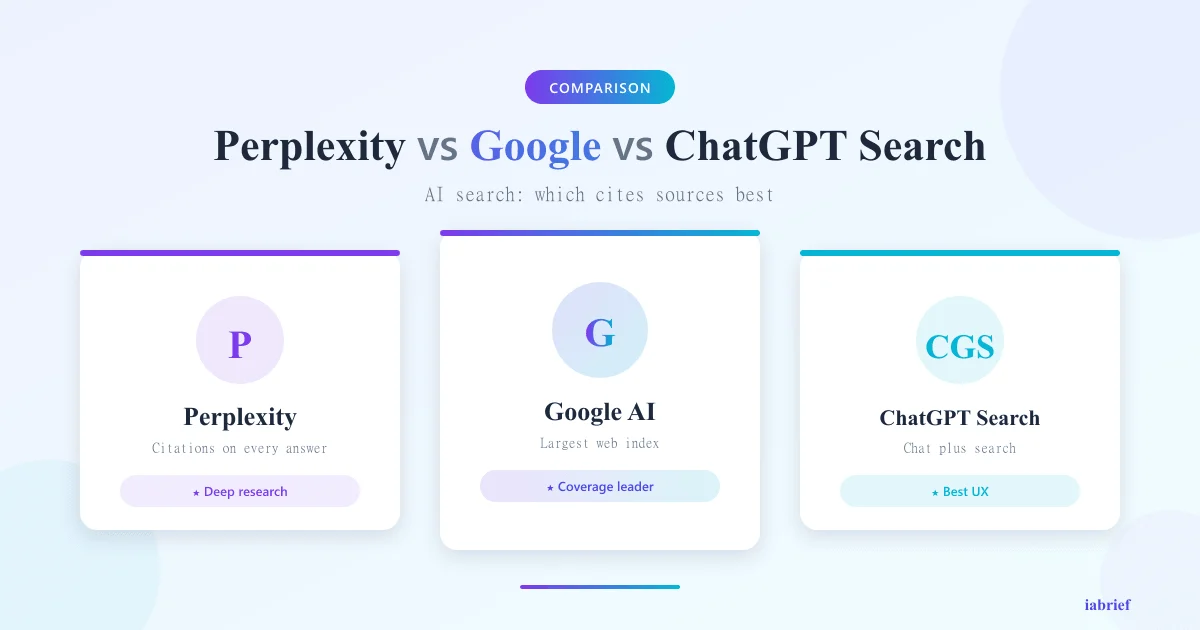
Perplexity vs Google vs ChatGPT Search: which is the best AI search in 2026?

In 2026, the question “perplexity vs google” stopped being about which link shows up first. It’s about who gives the best answer, with reliable sources, in the least time. And a strong third joined the race: ChatGPT Search, now integrated with GPT-5 with real-time citations and Deep Research mode.
This comparison analyzes the three most relevant AI search tools in 2026, Perplexity, Google (with AI Overviews and Gemini) and ChatGPT Search, under objective criteria: speed, citation quality, research depth, use cases (academic, daily, professional) and pricing.
Overview: three philosophies of search
Before features, it helps to understand how each one thinks about the search task.
Perplexity was born as answer engine first: the home screen is a question box, not a list of links. Each answer comes with numbered inline citations [1][2][3] that link to sources. It’s the tool that most pushes users toward “read the answer + check sources” instead of “open 10 tabs.”
Google evolved the classic search engine with AI Overviews (a Gemini-generated summary at the top of results) and Gemini integrated as a separate product. It keeps the link relevance heritage but now offers synthesized answers for queries that benefit from them.
ChatGPT Search is OpenAI’s search built into chat. In 2026, with native GPT-5, it combines model knowledge + real-time web search. Deep Research mode (launched in 2025) does extended research over minutes producing structured reports.
Perplexity in detail
Strengths
- Impeccable inline citations: every claim has a clickable source; transparency is the strongest point
- Pro Search (paid plan): runs multiple parallel queries and synthesizes
- Spaces / Collections: organize research into projects with persistent context
- Multi-model: pick Claude, GPT, Gemini, Sonar (own model) per search
- “Grounded answers” focus: low tendency to hallucinate vs pure chat
- Deep Research mode (launched in 2025): autonomous research over 3-10 minutes
Weaknesses
- Limited depth on very recent queries (last-hour news) — Google still leads here
- PT-BR results can favor English sources; depends on the query
- Free plan has low quota of Pro Search per day
- Feed personalization less rich than Google
Pricing
- Free: unlimited standard search, limited Pro Search (5/day)
- Pro: US$ 20/month, unlimited Pro Search, multi-model, Spaces, Deep Research
- Enterprise Pro: US$ 40/user/month — admin, SOC2 security, partial self-host option
Google (with AI Overviews + Gemini) in detail
Strengths
- Unmatched web coverage: still the largest index in the world
- News and real time: recent sources appear in seconds
- AI Overviews deliver synthesized answers on most common queries
- Local knowledge: maps, hours, phones, Google Maps integrations
- Gemini app for more conversational questions with Workspace integration
- Free for normal use
Weaknesses
- Citations in Overviews exist but the integration isn’t as clean as Perplexity
- AI Overviews had public stumbles (inappropriate recommendations in 2024), reliability returned high in 2026, but the memory lingers
- SEO weighs results: optimized pages compete with more authoritative sources
- No real “Deep Research” integrated into standard search (Gemini Advanced has its own version)
- Privacy: search data is the product
Pricing
- Google Search: free
- Google AI Pro (with Gemini Advanced + Deep Research): US$ 19.99/month
- Google AI Ultra: US$ 249.99/month — Veo 3, Gemini 3.1 Ultra, more quotas
ChatGPT Search in detail
Strengths
- Integrated with GPT-5: conversation flows without changing products
- Citations at the end of each answer with clickable links
- Deep Research mode: 5-30 minute autonomous research with structured report
- Memory between conversations: ask “remember that research about X?”
- Access to specialized GPTs combining search with custom instructions
- Excellent at synthesis: takes many sources and produces cohesive text
Weaknesses
- Very recent news coverage still behind Google
- Less visible citations during reading (appear at the end, not inline)
- Availability: some features (Deep Research, GPTs) require paid plan
- Higher latency than Perplexity on simple queries
- Source restrictions: due to commercial agreements, certain sources don’t appear
Pricing
- Free: ChatGPT Search included (with limits)
- Plus: US$ 20/month, comfortable use + Deep Research (monthly quota)
- Pro: US$ 200/month — expanded Deep Research, premium models, no practical rate limits
Head-to-head comparison
| Criterion | Perplexity | ChatGPT Search | |
|---|---|---|---|
| Inline citations | Excellent (numbered) | Good (Overviews) | Average (at end) |
| Web coverage | Good | Excellent | Good |
| Real-time news | Good | Excellent | Average |
| Answer synthesis | Excellent | Good | Excellent |
| Deep Research | Yes (Pro) | Yes (AI Pro) | Yes (Plus+) |
| Multi-model | Yes | No (Gemini only) | No (GPT only) |
| Memory/persistent context | Spaces (Pro) | Limited | Yes |
| PT-BR | Good | Excellent | Good |
| Maps/local | Limited | Excellent | Limited |
| Privacy | Average | Low | Average |
| Paid entry price | US$ 20/month | US$ 19.99/month | US$ 20/month |
| Functional free plan | Yes | Yes (full) | Yes |
When to use each
Use Perplexity if you:
- Do frequent research and want full source transparency (inline citations)
- Are an academic, journalist, analyst, lawyer, doctor, professions where source matters
- Want multi-model flexibility without leaving the product
- Work on long projects where Spaces help organize
- Value absence of bad SEO in results
Use Google if you:
- Search for local info: addresses, hours, maps, phones
- Need real-time news coverage of the last hours
- Want the broadest web coverage for niche queries
- Already on Workspace and want Docs/Sheets integration via Gemini
- Are fine with the unlimited free plan
Use ChatGPT Search if you:
- Already pay ChatGPT Plus/Pro and want to use the included search
- Do extended research with Deep Research (10-30 page reports)
- Work in a conversational flow: research, refine, expand, generate final text
- Use specialized GPTs with built-in search
- Need memory between sessions for long projects
Academic vs daily vs professional
Academic and scientific research: Perplexity > ChatGPT Search > Google. Perplexity’s inline citations and multimodel Deep Research win. To check paper references and build bibliography, it’s the best.
Daily (weather, restaurant, hours): Google > Perplexity > ChatGPT. Real time and local weigh here.
Professional market research: Tie Perplexity / ChatGPT Deep Research. Both produce quality structured reports. Perplexity wins on source transparency; ChatGPT wins on writing-flow integration.
Programming and tech questions: ChatGPT Search > Perplexity > Google. GPT-5 synthesizes better when the result needs to become code.
Urgent news: Google > Perplexity > ChatGPT.
What about Deep Research? Worth it?
In 2026, all three offer extended autonomous research modes:
- ChatGPT Deep Research: 5-30 min, produces long reports (10-30 pages), excellent at academic synthesis
- Perplexity Deep Research: 3-10 min, faster, with cleaner citations
- Google Deep Research (in Gemini Advanced): good but less polished than the other two
For critical research where depth justifies time, ChatGPT Deep Research generally leads in output quality. For frequent research where speed matters, Perplexity is better.
Conclusion: complementarity beats single choice
If the question is “perplexity vs google or ChatGPT?”, the honest answer is: use all three, each for a query type.
- Perplexity wins on transparency, citations and professional research
- Google wins on coverage, real time and local info
- ChatGPT Search wins on conversational flow, long Deep Research and writing integration
If you can only pay for one plan: Perplexity Pro if you research a lot; ChatGPT Plus if you already use chat for other things; none (free Google is enough) if your research is casual.
Most professionals in 2026 keep Google as a pocket tool (free, always available) + one paid (Perplexity or ChatGPT) for serious research.
For more comparisons, read our AI models guide for 2026 and the comparison of DeepSeek R1, o3 and Claude — models behind these tools.
FAQ
Is Perplexity better than Google?
For research with sources and synthesized answers, yes. For local info, minute-by-minute news and raw web coverage, Google still leads.
Does ChatGPT Search replace Google?
For deep research and conversation, often yes. For everyday queries (cinema, restaurant, map), no.
Does Perplexity have a decent free plan?
Yes, but with a limit of 5 Pro Searches per day. For heavy use, Pro at US$ 20/month pays off.
Best for academics?
Perplexity, for inline citations. ChatGPT Deep Research is strong for long reports.
Can I use Google AI Overviews for free?
Yes. AI Overviews appear in normal results at no cost, based on Gemini.
Which produces the most reliable answers?
Perplexity has the lowest practical hallucination rate, with citations forcing grounding. ChatGPT Search and Google AI Overviews are reliable but require more manual checking.
Article produced in May 2026. Pricing and features based on public data available at publication.
Related reading
To go deeper, we recommend these iabrief articles:
- OpenAI’s $852 Billion Valuation in 2026: The Largest Private Funding Round in History
- Week in AI: agents at work, Gemini in cars and AI beating doctors (May 3, 2026)
- How to Use Google Veo 3.1 to Create AI Videos: Step-by-Step Tutorial (2026)
Official sources
For deeper context, see the official sources and authoritative references below: