Anthropic Hits a $965 Billion Valuation in 2026 and Overtakes OpenAI: The Throne Swap in the AI Race

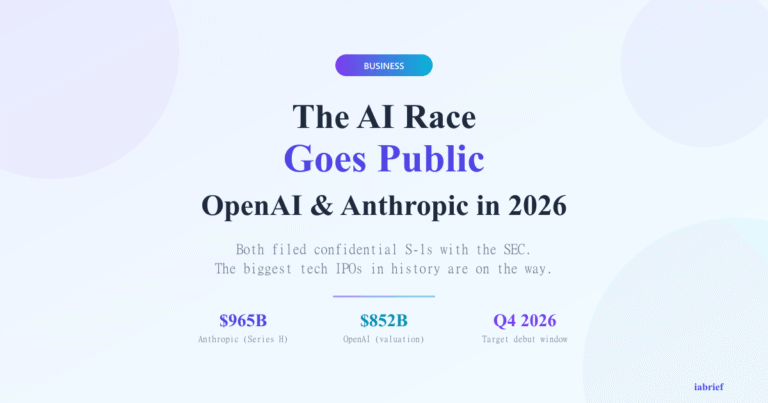
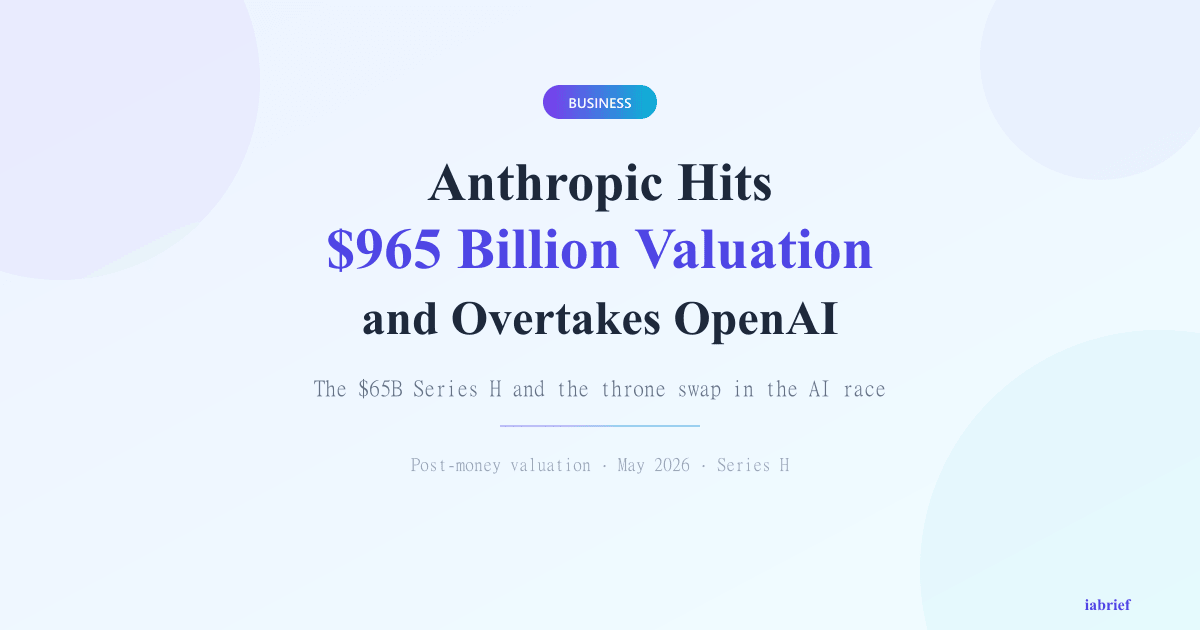
Anthropic, the company behind Claude, closed one of the largest private funding rounds in history in May 2026 — and did what looked unlikely twelve months ago: it overtook OpenAI to become the most valuable AI startup in the world. The numbers: $65 billion raised at a $965 billion post-money valuation in its Series H, announced on May 28. That tops the $852 billion OpenAI reached in March — the first time Anthropic has passed its rival on the valuation scoreboard.
The story started smaller. In late April and through May, reports described talks for “$30 billion at a valuation above $900 billion.” Investor demand was so strong that the check more than doubled and the price rose with it. If you use Claude, ChatGPT, or Gemini, build with AI, sell digital products, or run automations at work, this matters — because it changes who sets the pace of the industry. This edition is a direct sequel to our deep dive on OpenAI’s $852 billion valuation. Let’s break down the throne swap.
What Happened: The Round That Flipped the Race
Anthropic confirmed the Series H on May 28, 2026. The raw numbers:
- Round size: $65 billion (Series H)
- Post-money valuation: $965 billion
- Revenue run-rate: $47 billion (crossed earlier in May)
- Status: still private, with a confidential S-1 filed with the SEC on June 1 and an IPO possible as early as the second half of 2026
Some perspective: in February 2026, Anthropic had closed its $30 billion Series G at a $380 billion valuation. In just over three months, the company more than doubled its own price and jumped toward the $1 trillion mark. That pace of re-pricing is rare even by AI standards.
And one detail captures the round’s ambition: on the same day as the announcement, Anthropic shipped Claude Opus 4.8, claiming the model beats OpenAI’s GPT-5.5 and Google’s Gemini 3.1 Pro on several coding benchmarks. Closing a record raise and launching a frontier model on the same day is a calculated communications play — the money lands with the product proof already on the table.
The Co-Leads Behind the Round
Unlike OpenAI, anchored by four corporate giants (Amazon, Nvidia, SoftBank, and Andreessen Horowitz), Anthropic’s round leaned mostly on growth funds and public-markets asset managers — a profile closer to a pre-IPO company than a startup.
The four primary co-leads
Sequoia, Dragoneer, Altimeter, and Greenoaks led the round. These are growth funds with a track record of entering close to a public offering — a signal they’re betting not only on the AI thesis but on near-term liquidity via IPO. Altimeter CEO Brad Gerstner summed up the thesis: “Claude’s latest advancements have driven large-scale adoption among the world’s most demanding organizations. This momentum positions Anthropic to lead the next phase of AI innovation.”
The second tier of leaders
Joining as co-leads were Capital Group, Coatue, D1 Capital Partners, GIC, ICONIQ, and XN — a mix of traditional asset managers (Capital Group), sovereign wealth funds (Singapore’s GIC), and tech hedge funds. The presence of “public-markets” institutional money is telling: these are exactly the investors who normally buy public shares, positioning themselves ahead of the listing.
The strategic investors
Among the significant names are General Catalyst, Blackstone, Brookfield, Fidelity, Baillie Gifford, Lightspeed, Jane Street, DST Global, Insight Partners, and Temasek. There’s also the infrastructure component: partners like Samsung, SK Hynix, and Micron (memory and chips), plus roughly $15 billion in committed funds from hyperscalers, including $5 billion from Amazon. In other words, part of the capital comes tied to hardware and cloud supply — the same “virtuous circle” pattern we saw in OpenAI’s round.
Why Anthropic Managed to Pass OpenAI
This wasn’t luck or narrative. Three vectors explain the flip.
1. Revenue growing at an absurd pace
Anthropic’s run-rate jumped from about $9 billion at the end of 2025 to $47 billion by early May 2026 — and the company expects to clear $50 billion in the second half. That growth is driven mainly by enterprise adoption and Claude Code, the AI coding tool that has become a standard in many engineering teams.
2. The path to profit
Here’s perhaps the most important and least-discussed data point: Anthropic told investors it projects its first-ever quarter of operating profit — roughly $559 million in Q2 2026, on revenue of $10.9 billion (a 130% jump from $4.8 billion in Q1). In an industry where nearly everyone burns cash, signaling operating profit ahead of the rival is an enormously powerful valuation argument.
3. Technical leadership at the right moment
Claude Opus 4.8 arrived claiming to beat GPT-5.5 and Gemini 3.1 Pro at coding — the most monetizable segment of AI today, because companies pay a premium for reliable code. If you want to understand how to compare model generations, check our analysis on the best AI model in 2026.
Why This Valuation Might Not Hold
No $965 billion thesis is risk-free. The bear case:
- Aggressive multiple. $965 billion on a $47 billion run-rate is expensive even for hyper-growth SaaS. The math only works if the revenue curve keeps doubling — and doubling gets harder, mathematically, every quarter.
- Revenue concentration. Much of the jump comes from enterprise and Claude Code. If a competitor ships an equivalent, cheaper coding tool, the most profitable revenue is exposed.
- Commoditization. Each generation, open models (DeepSeek, Llama, Mistral) close in on the frontier. Claude’s technical moat is real today, but history shows it lasts months, not years.
- Regulation. Just after the round, on June 4, Anthropic itself began publicly advocating for a “global pause” on frontier AI development, citing risks from models’ self-improvement — a move critics, including investor David Sacks, read as “regulatory capture” meant to hobble competition. Either way, chip policy, antitrust, and federal oversight can re-price the company. For the landscape, see our overview of US AI regulation in 2026.
Whoever bought in at $965 billion is betting the combination of growth + near-term profit + technical lead beats those objections. It’s a reasonable bet — but it’s still a bet.
Where the Money Goes
Anthropic was direct about the use of proceeds: advance safety and interpretability research, expand compute to meet demand for Claude, and scale the products and partnerships customers rely on. In practice, that breaks into three fronts.
1. Compute (the lion’s share)
The bulk goes into GPUs, memory chips, and data centers. Hence the deals with Samsung, SK Hynix, and Micron, and the $15 billion committed by hyperscalers. Anthropic needs massive inference capacity to sustain Claude’s growth without degrading the experience — and compute is the industry’s number-one bottleneck.
2. Safety and interpretability
Anthropic differentiates itself with a “safe AI” banner. Part of the capital goes into interpretability research — understanding from the inside how models make decisions. It’s not just ethics: it’s also regulatory positioning and enterprise branding, where large customers demand guarantees.
3. Product and partnerships
Scaling Claude Code, enterprise integrations, and the app ecosystem around Claude. This is the front that sustains the revenue that justifies the valuation.
What This Means for You as a User
The throne swap doesn’t change your app overnight, but it reshuffles the board. What to expect:
Fiercer competition — and that’s good for you. With Anthropic, OpenAI, and Google now tied in valuation and capability, the incentive to ship better models faster goes up. Releases like Claude Opus 4.8, GPT-5.5, and Gemini 3.1 Pro landing in sequence are a direct product of that fight.
Pricing under pressure from both sides. In the short term, nobody wants to be first to raise prices and lose users. But with everyone chasing operating profit, hikes on paid tiers and tighter free-tier limits are plausible in 12–18 months. The practical advice stays the same: treat AI as infrastructure, and hold at least one paid plan if you use it daily.
Don’t marry a single vendor. The lesson of the swap is that leadership changes hands fast. Anyone depending on one model is hostage to someone else’s pricing and roadmap.
What This Means for Creators and Founders
Here the impact is more strategic. Three effects to watch:
1. Claude becomes a “permanent” platform. At nearly $1 trillion and on a path to IPO, Anthropic has gone from a risky bet to reliable infrastructure to build on. If you build SaaS, agents, or automations, you can adopt the Claude API with less fear the company disappears.
2. AI coding is the hot lane right now. The revenue jump came from Claude Code. For creators who teach, sell courses, or do automation services, content about AI-assisted development has rising demand. Pair it with our guide on autonomous AI agents in 2026 and the step-by-step on how to create an AI blog that ranks on Google.
3. The evergreen content window on Claude opens now. Unlike OpenAI, which already has an ocean of content, “Claude” is still a less-crowded niche in many markets. Whoever produces solid SEO content about Claude, Claude Code, and Anthropic now catches the wave earlier.
The Race Goes On: Where Everyone Else Stands
Anthropic’s flip reset the ceiling, but the contest stays four-cornered:
- OpenAI remains enormous, with ChatGPT among the most-visited sites in the world and the $852 billion from its March round. Losing the “most valuable” title is symbolic, but its user base and distribution are still the largest in the sector.
- Google DeepMind operates with a structural advantage: distribution via Search, Android, and Workspace, plus proprietary TPU infrastructure. It doesn’t need to raise — it has cash, and it shipped Gemini 3.1 Pro into the fight.
- xAI (Musk) keeps raising large rounds, with a thesis more ideological than economic, but a real check.
- Meta runs the Llama open-source path — it doesn’t compete on subscriptions, it competes on ecosystem, accelerating the thesis that open models commoditize closed ones.
- DeepSeek and Chinese labs keep delivering frontier-grade models at training costs orders of magnitude lower. Geopolitics is the wild card.
The takeaway: value leadership in AI now changes hands in months, not years. For users, that means more choice and more innovation. For investors and builders, it means betting on a “single winner” is risky.
Frequently Asked Questions
Is Anthropic really worth more than OpenAI now?
In private valuation, yes: $965 billion versus the $852 billion OpenAI reached in March 2026. It’s the first time Anthropic has passed its rival on that scoreboard. Keep in mind a private valuation is the price of the last round, not a public market cap — it can move fast in either direction.
Where did the “$900 billion” figure come from?
That was the early-talks number, reported between late April and May 2026 (roughly $30 billion at a valuation above $900 billion). Demand was so high that the round closed bigger: $65 billion at $965 billion.
Is Anthropic profitable?
Not yet on a full-year basis, but the company projected to investors its first quarter of operating profit — around $559 million in Q2 2026, on $10.9 billion in revenue. Reaching operating profit ahead of its rival is one of the pillars supporting the valuation.
When is Anthropic’s IPO?
The company filed a confidential S-1 with the SEC on June 1, 2026, and reports point to a possible debut as early as the second half of 2026. There’s no firm date — confidential filings let a company delay or adjust depending on market conditions, and Anthropic itself hasn’t set a price, ticker, or timeline. For the full fight over who lists first, see our breakdown of the OpenAI vs. Anthropic IPO race.
Will this move the price of Claude or ChatGPT?
No change expected near-term — competition holds prices down. In the medium term, with everyone chasing profit, hikes on paid tiers and free-tier limits become more likely. If you use AI daily, keeping a paid plan still makes sense.
How should creators and founders position themselves?
Build on the ecosystem, but keep portability. Use the Claude API where it makes sense, but preserve the ability to migrate to GPT, Gemini, or open models. Evergreen content about Claude, Claude Code, and AI coding is a solid bet right now.
What to Watch From Here
The coming months will tell whether Anthropic cements the throne or OpenAI strikes back. Three things to monitor:
- Does the operating profit materialize? If the projected profit quarter becomes reality, the valuation gains support that’s hard to challenge. If it slips, the thesis cracks.
- Does the second-half IPO happen? Going public would be the first major public test of the AI thesis — and would set the benchmark for OpenAI and the rest.
- Does the technical lead hold? Claude Opus 4.8 leads on code today, but GPT-5.5 and Gemini 3.1 Pro won’t stand still. Each one’s next generation will redraw the ranking.
To follow upcoming updates on Anthropic, OpenAI, and the practical impact on the AI market, subscribe to the iabrief newsletter — one email per week, no hype, only what matters.