OpenAI and Anthropic IPO: The Race of the World’s Biggest AI Companies to the Stock Market in 2026

The AI race just switched tracks. After years of raising ever-larger private rounds, the two most valuable AI companies on earth took, within a few weeks of 2026, the step the market had been both expecting and dreading: they started preparing to go public. On June 1, 2026, Anthropic — the maker of Claude — confirmed it had made a confidential S-1 filing with the SEC, the US market regulator. OpenAI, the maker of ChatGPT, made its own confidential filing a few days earlier, on May 22, 2026.
This is not a technicality. It is an entire industry transitioning from private venture capital to the public scrutiny of the stock market. For the first time, everyday investors will be able to buy — and lose money on — a direct slice of the AI frontier. This piece breaks down what is actually happening, what an AI IPO means in practice, the real risks involved, and what to watch over the coming months.
What Happened: Two Lines for the Same Bell
The numbers are large enough to feel unreal, but they are confirmed by the companies themselves and by the financial press.
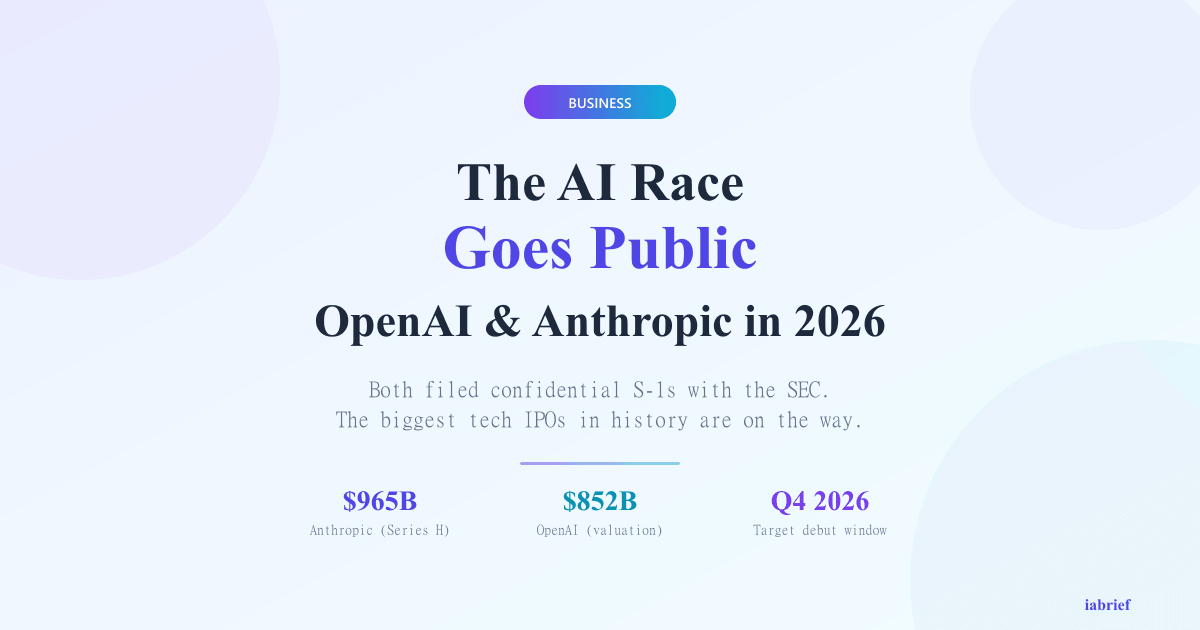
Anthropic. On May 28, 2026, the company closed its Series H: $65 billion raised at a $965 billion post-money valuation — nearly the $1 trillion mark. The round was led by Altimeter, Dragoneer, Greenoaks, and Sequoia, and co-led by Capital Group, Coatue, D1, GIC, ICONIQ, and XN. Three days later, on June 1, came the confidential IPO filing. To grasp the speed: in February 2026, Anthropic was valued at $380 billion in its Series G. In under four months, the valuation more than doubled. We break down the round and the overtaking of OpenAI in our analysis Anthropic hits a $965 billion valuation and passes OpenAI.
OpenAI. The company filed its confidential S-1 on May 22, 2026, targeting a fourth-quarter debut — possibly as early as September — at a valuation between $852 billion and $1 trillion. The $852 billion figure comes from the record-breaking $122 billion private round closed in March 2026, which we covered in our analysis of OpenAI’s $852 billion valuation.
Both chose the same banks to run the offerings: Goldman Sachs and Morgan Stanley. OpenAI is also in talks to add Citigroup and JPMorgan to the syndicate. In other words, Wall Street is simultaneously assembling the two largest tech IPOs in history — competing for the same window and the same pool of capital.
“Confidential Filing”: What It Actually Means
The jargon is worth clarifying, because it misleads. A confidential S-1 filing is not the IPO. It is a draft prospectus submitted to the SEC privately, allowed for companies under certain eligibility thresholds (the “emerging growth” regime). It kicks off regulatory review without exposing the numbers to the public — and, crucially, without obligating the company to go public.
Anthropic was explicit: the filing “gives us the option” to go public after the SEC completes its review, and the actual IPO “will depend on market conditions and other factors.” In other words: share count, price, and date do not exist yet. The process typically takes 60 to 90 days before a public version of the prospectus appears — which puts the first real look at the detailed numbers somewhere between late July and September 2026.
For investors, lesson number one is patience: we are at the start of a process, not the end. Anyone eager to “buy the stock tomorrow” needs to understand that not even the company knows yet when — or whether — the offering will happen.
The Numbers Behind the Headlines (and the Warning Sign)
This is where investors need to stop looking only at the valuation and start looking at the income statement.
Revenue is growing at an absurd pace. Anthropic went from a run-rate (annualized revenue) of about $9 billion at the end of 2025 to roughly $47 billion in May 2026 — driven by enterprise adoption of Claude. OpenAI hit a run-rate of about $25 billion in February, billing close to $2 billion per month, with 50 million consumer subscribers and 9 million business users.
And here comes the “but.” Growing revenue is not the same as turning a profit. In the first quarter of 2026, OpenAI reported a negative 122% operating margin — meaning for every $1 of revenue, the company burned an additional $1.22. Training frontier models and running inference at scale costs fortunes in GPUs and energy. Both companies are, right now, selling growth at a loss, betting that future scale will deliver margin. It might work — Amazon took years to turn a profit and became one of the largest companies in the world. But the losses are real and they are in the prospectus.
This is the point that separates an AI IPO from a bond: you are buying a thesis about the future, not a present-day cash flow. For more on how the market has been pricing these theses, see our analysis of generative AI and financial markets in 2026.
Why Go Public Now?
If they can raise tens of billions in private markets, why face the paperwork, exposure, and volatility of the stock market? Three main reasons:
1. The private checkbook is hitting its ceiling
Even the world’s largest funds have a limit. Sustaining the compute spending curve (GPUs, data centers, energy) requires capital at a scale only the public market, with its deep liquidity, can provide on a recurring basis. The stock market is, essentially, the largest money tap on the planet.
2. Liquidity for employees and early investors
Employees received shares over years and want to be able to sell them. Early investors want to realize gains. An IPO unlocks that liquidity in an organized way, rather than relying on one-off secondary rounds.
3. Market window and competitive race
Nobody wants to be second. Going public first secures priority access to investor appetite, sets the sector’s “reference price,” and generates headlines that reinforce leadership. With Anthropic and OpenAI in the same line — and SpaceX also eyeing the market in the same period — there is a fight for limited attention and capital.
What Changes for Everyday Investors
This is the central question. Until now, investing in OpenAI or Anthropic was the privilege of institutional funds and a handful of ultra-wealthy individuals (OpenAI even opened a restricted retail tranche, with a $500,000 minimum for accredited investors). With the IPO, that changes.
The good news: OpenAI CFO Sarah Friar said publicly that the company plans to reserve a slice of IPO shares for retail investors — ordinary people, not just institutions. Per the financial press, the plan is to set aside roughly 30% of the offering for retail, echoing a similar move by SpaceX. The decision followed an accredited-investor private placement that was heavily oversubscribed — retail buyers committed about three times the amount the company had expected. That is a rare signal of democratization in such hotly contested offerings.
How an everyday investor can get exposure:
- A brokerage account. Platforms with access to US markets let you buy shares listed on the Nasdaq/NYSE as soon as they start trading.
- AI-themed ETFs. Once listed, the shares tend to be incorporated into AI and tech ETFs, offering diversified exposure without betting on a single company.
- Wait for the dust to settle. You do not have to buy on day one. Building a position gradually after the listing reduces the risk of buying at the post-IPO peak.
The important caveat: heavily oversubscribed IPOs are rarely widely available to retail at the offer price. Banks and large funds get priority allocation. In practice, the everyday investor almost always buys on the first day of trading — often already elevated, after the initial “pop.” And that is exactly where the risk lives.
The Biggest Risk: Post-IPO Volatility
The recent history of tech stocks is a string of warnings for anyone who confuses hype with guaranteed returns. The pattern repeats: the stock spikes on day one, draws in retail investors, then collapses once the market starts pricing reality instead of the dream.
Real examples of declines from the IPO price (or from the initial peak):
- Coinbase opened well above its reference price on debut (it was a direct listing) and fell more than 50% in the months that followed.
- Rivian lost nearly 90% of its value after the IPO.
- Robinhood dropped roughly 90% in its first year.
- Lyft fell almost 80%.
- Even Meta (Facebook) declined more than 50% after going public in 2012 — before becoming one of the market’s greatest success stories.
That last one is instructive: brutal short-term volatility does not mean the company will fail. It means the entry price matters enormously and the investor’s stomach will be tested. Buying an AI stock on day one and watching it drop 40% in three months is an entirely plausible scenario — even if the company is, over the long run, a winner.
For these IPOs specifically, there are extra risk factors: the current operating losses, dependence on a handful of chip suppliers, possible commoditization by open models, and regulation. It is worth following our overview of US AI regulation in 2026, because regulatory shifts can reprice these stocks overnight.
Frequently Asked Questions
What is the difference between the OpenAI and Anthropic IPOs?
They are parallel processes, with the same banks (Goldman Sachs and Morgan Stanley). OpenAI filed first (May 22), has more absolute consumer revenue (ChatGPT, 50 million subscribers) and declared operating losses. Anthropic filed on June 1, is valued at $965 billion after Series H, and has strong enterprise traction with Claude. Neither has set a date, price, or share count.
When will the IPOs actually happen?
There is no official date. The confidential filing starts an SEC review that typically takes 60 to 90 days. OpenAI is targeting the fourth quarter of 2026, possibly September; the most-cited window for Anthropic is October 2026. But both conditioned the offering on “market conditions” — it could slip or not happen at all.
How can a retail investor get exposure to these companies?
Open a brokerage account with access to US markets and buy on the Nasdaq/NYSE once they start trading, or invest through AI ETFs that include these stocks. Remember that retail rarely gets allocation at the offer price — you usually buy on the first trading day, often after the initial pop.
Is it worth buying right at the debut?
It is the highest-risk moment. Post-IPO volatility for hypergrowth companies is historically brutal (Coinbase, Rivian, Robinhood, Lyft fell 50% to 90%). Buying in day-one euphoria is usually expensive. If you have long-term conviction, it makes more sense to build a position gradually and accept sharp swings than to bet everything on the debut.
Are $965 billion and $1 trillion fair valuations?
Based on current revenue, they are expensive — multiples typical of hypergrowth companies. The math only works if revenue keeps growing at a high rate for years and margins turn positive. Today both operate at a loss. It is a bet on future execution, not on present fundamentals.
What could go wrong after the IPO?
Slowing revenue, persistent operating losses, commoditization by open models (Llama, DeepSeek), chip restrictions, antitrust action, and regulatory changes. Any of these can knock the stock down quickly — and retail investors are usually the last to react.
What to Watch From Here
The coming months will decide whether 2026 goes down in history as the year AI hit the stock market on solid footing — or as the top of a cycle. Three things to monitor closely:
- The public version of the prospectuses. When the S-1 comes out of confidentiality (likely between July and September), we will see, for the first time, the detailed revenue, cost, and loss figures. It is the single most important read.
- Market conditions. Both conditioned the IPO on investor appetite. Sharp drops in the Nasdaq or in chip stocks could delay everything. Keep an eye on the broader tech market mood.
- The regulatory reaction. Antitrust, chip policy, and federal AI oversight can reprice these stocks. Changes here matter more than any model benchmark.
Above all: treat an AI IPO for what it is — a very high-risk, high-potential-reward bet, not a savings account. Invest only what you are willing to watch swing hard, and prioritize long-term conviction over headline euphoria.
To stay on top of the next updates, subscribe to the iabrief newsletter — one email per week, no hype, only what matters.